
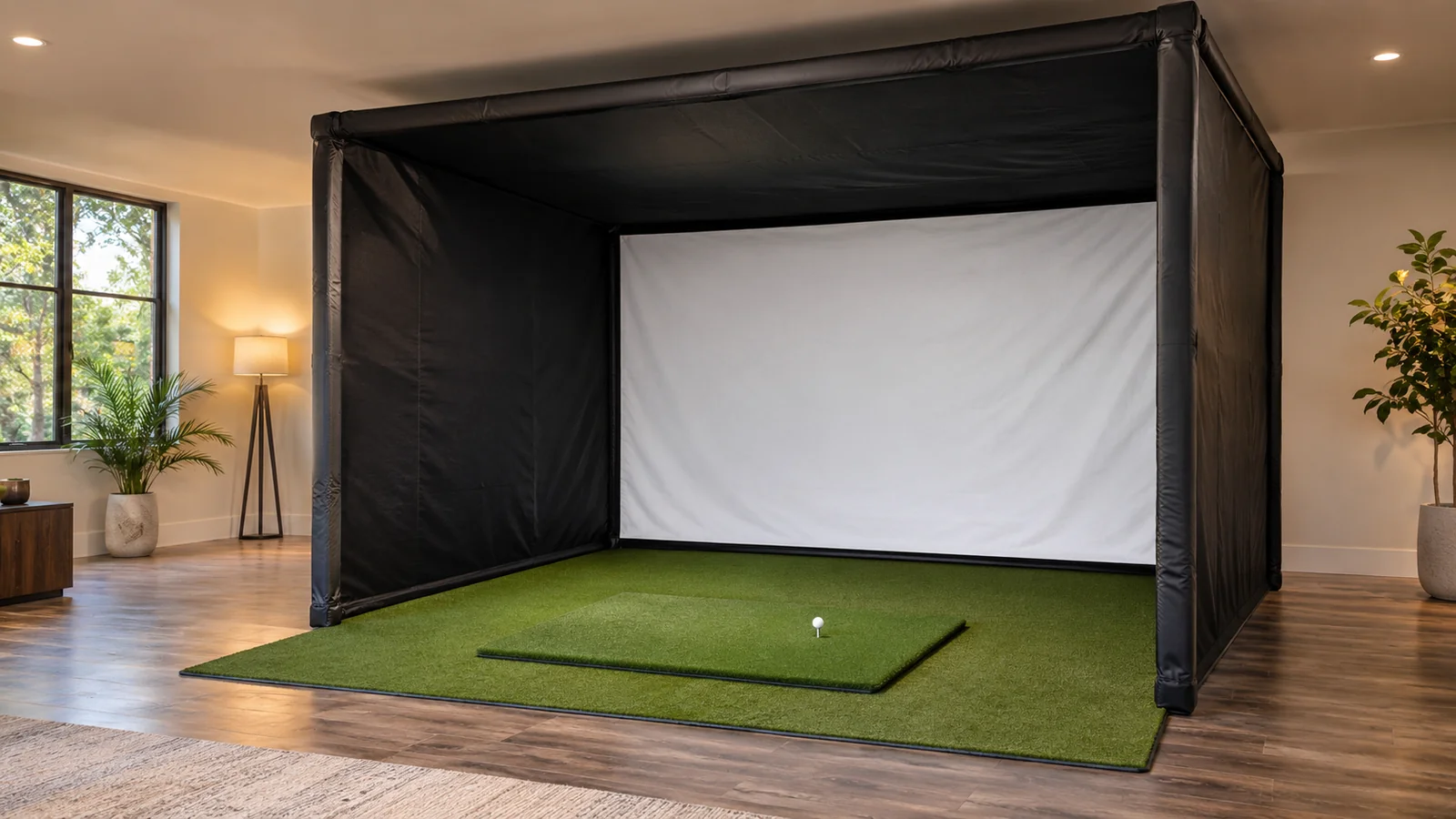
Before comparing systems: measure the frame, not its label
Manufacturer dimensions are larger than the marketing name. The SIG8 frame measures about 8 ft 4 in wide × 8 ft 4 in high × 5 ft deep; the SIG10 is about 10 ft 10 in wide × 8 ft 4 in high × 5 ft deep; the SIG12 is about 12 ft 2 in wide × 9 ft 4 in high × 5 ft deep. The maker separately recommends rooms around 10 × 16 × 9 ft, 12 × 18 × 9 ft and 14 × 20 × 10 ft respectively (width × length × height). Those are product-specific recommendations, not generic safety guarantees. Confirm the intended configuration on the latest dimensions chart before ordering. Check doorway access, garage tracks and swing clearance separately.
At a glance: comparison table
| Option | Good fit | Important trade-off | Check Price |
|---|---|---|---|
| SIG8 Golf Simulator Enclosure | compact square-screen bay | A narrower strike zone and square aspect ratio can be less forgiving for a wide variety of players | Search on Amazon |
| SIG10 Golf Simulator Enclosure | balanced dedicated home setup | Larger than its name suggests: a ten-foot usable screen needs a wider outer frame and still more total room | Search on Amazon |
| SIG12 Golf Simulator Enclosure | large image and wider hitting zone | Frame height and width rule out many small garages; usually a more expensive project once lighting and projector upgrades are considered | Search on Amazon |
| Carl’s Place DIY C-Series Enclosure Kit | configurable DIY frame approach | More assembly decisions and opportunities for omissions than a fully supplied frame package | Search on Amazon |
| SIG Custom DIY Golf Simulator Enclosure | custom fit when stock sizes fail | A custom enclosure is not automatically cheaper once local pipe, labor, delivery and possible mistakes are included | Search on Amazon |
| SIGPRO Commercial Enclosure | higher-use or professional installation | More expensive and less appropriate for a temporary garage shared with a car | Search on Amazon |
| GoSports simulator enclosure | Matched frame, surround and screen | Choose actual kit size; monitor, mat and projector separate | 10 × 8 ft 12 × 9 ft 14 × 8 ft |
| GoSports Range Cage ELITE | Net-cage layout with impact screen | 8×8-ft screen format; outer frame and safe room fit checked separately | View on Amazon |
For enclosure candidates, compare the included frame, screen, side barriers and dimensions—not just a photograph of an assembled simulator bay.
1. SIG8 Golf Simulator Enclosure — compact square-screen bay
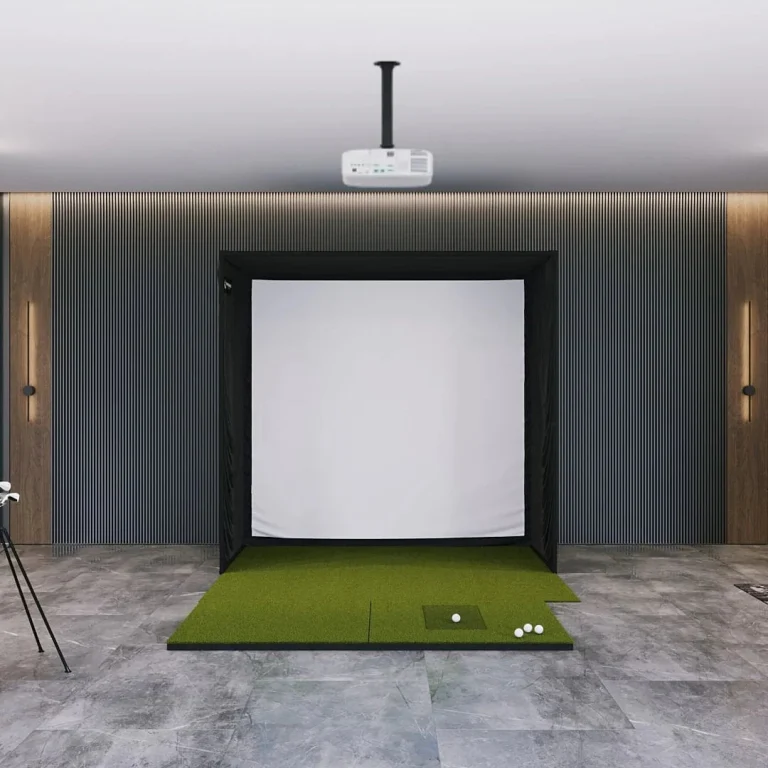
The SIG8 is the smaller named enclosure in The Indoor Golf Shop’s standard lineup, with a frame about 8 ft 4 in wide and 8 ft 4 in high and a depth of roughly five feet. The visible screen is approximately 7 ft 7 in square. It suits certain narrow rooms, but “compact” does not mean a golfer can safely swing in a room that barely accommodates the frame. Allow side buffer, ball flight and the clearance required by the chosen launch monitor.
A square image can be a good fit for simulator software that supports 1:1 output and for compact short-throw projectors. It can be less natural for widescreen entertainment. The manufacturer’s included screen and frame have a matching specification; do not assume that the shop photograph also means a projector, monitor or PC is included.
Trade-off: A narrower strike zone and square aspect ratio can be less forgiving for a wide variety of players.
Before ordering: Confirm actual outer dimensions, side protection, pipe kit and screen replacement availability for the exact SIG8 package.
2. SIG10 Golf Simulator Enclosure — balanced dedicated home setup
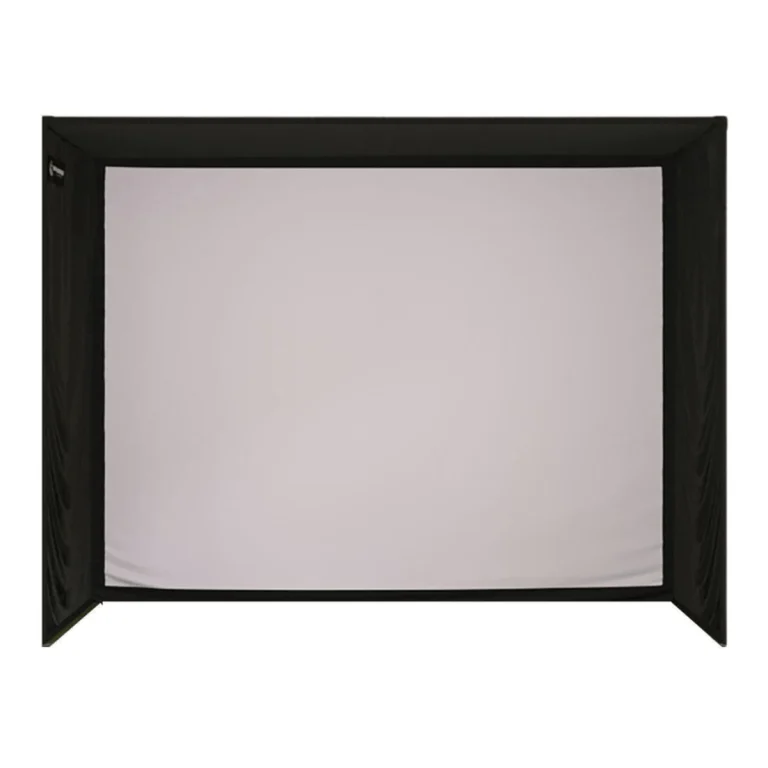
The SIG10 has an overall frame approximately 10 ft 10 in wide by 8 ft 4 in high, around five feet deep; its visible 4:3 impact image is roughly 10 ft 1 in by 7 ft 7 in. For many homes, this may be a more balanced bay than an extra-wide model. It provides a generous landing image while still fitting some standard-size bonus rooms and garages after careful clearance planning.
This is the model to consider when the room has about twelve feet or more practical working width, although safe swing and side clearance must be checked individually. The screen shape can suit golf play well. If you expect an overhead projector or monitor, map their mounting positions before assembling the enclosure.
Trade-off: Larger than its name suggests: a ten-foot usable screen needs a wider outer frame and still more total room.
Before ordering: Ask whether the exact seller SKU is enclosure-only or a simulator package with additional gear.
3. SIG12 Golf Simulator Enclosure — large image and wider hitting zone
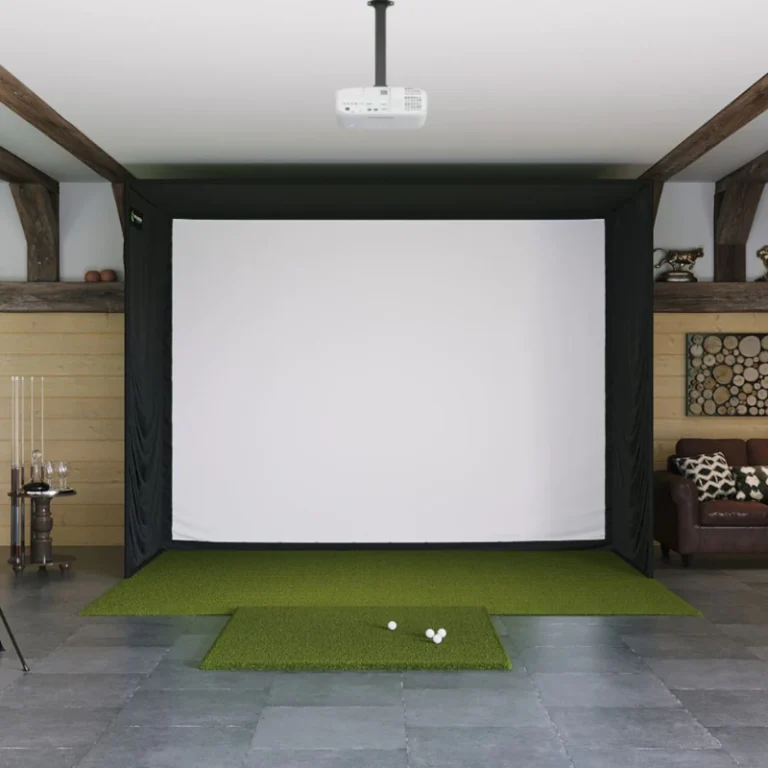
The SIG12 frame is approximately 12 ft 2 in wide by 9 ft 4 in high and five feet deep. Its larger 4:3 image can make a projected round more immersive and provide more visual separation between golfers and side curtains. That benefit requires a correspondingly larger room and often a stronger projector plan. An enclosure that fits against a wall in a floor plan may still interfere with lighting, overhead doors or club swing arcs.
If several players share a simulator, check both right- and left-handed swing clearances from the intended ball position. A wider enclosure can help containment but does not automatically create enough space for both swing directions. The larger picture also spreads available projector output across more area.
Trade-off: Frame height and width rule out many small garages; usually a more expensive project once lighting and projector upgrades are considered.
Before ordering: Measure the actual outer frame and confirm the screen aspect ratio and ceiling installation clearance.
4. Carl’s Place DIY C-Series Enclosure Kit — configurable DIY frame approach
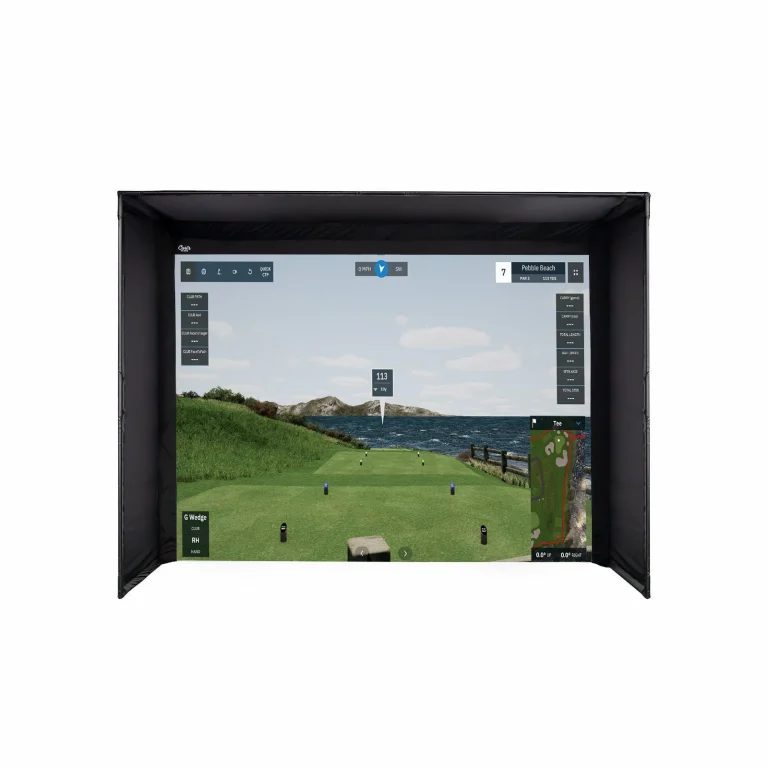
Carl’s DIY C-Series provides an impact screen, BlackStop surround and frame fittings for a range of enclosure formats. The seller describes pipe framing as a separate selection or add-on, which is crucial: buying the fabric-and-fittings option should not be assumed to deliver every length of framing tube. The customizable setup is interesting where a standardized SIG frame is the wrong proportion for the room.
Before selecting a size, create a floor plan showing outer dimensions, visible impact screen, wall buffer and the intended room width. Then itemize pipe requirements, mounting feet, padding, net curtains and the manufacturer’s permitted attachment method. Build tolerances matter: a few inches can decide whether a screen mounts correctly.
Trade-off: More assembly decisions and opportunities for omissions than a fully supplied frame package.
Before ordering: Confirm whether the selected cart includes cut-to-size pipes, screen finishing and padding; Carl’s lists rear buffer guidance in its installation materials.
5. SIG Custom DIY Golf Simulator Enclosure — custom fit when stock sizes fail
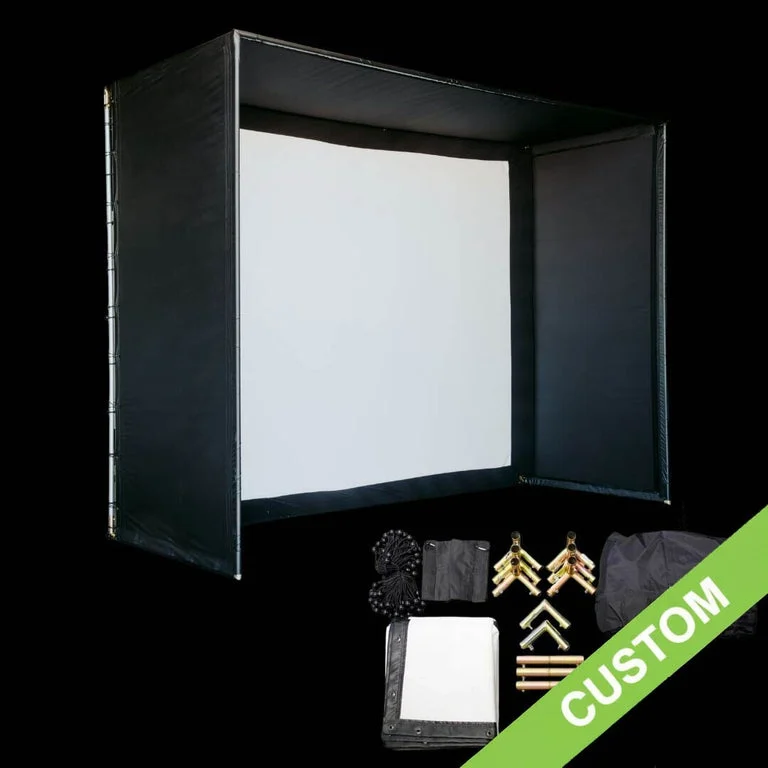
The SIG Custom DIY option allows the buyer to specify a nonstandard room opening, with a matching screen, surround and fitting kit. According to The Indoor Golf Shop, custom DIY framing may use 1-inch EMT pipe obtained locally rather than included in the screen-and-fittings package. This is a serious advantage when a bay has a beam or narrow niche, provided the buyer has the measurements and installation skills to execute the plan.
Use a single drawing with outer frame, visible image, door movement, impact containment and projector cone. Obtain the final cut list and check each crossbar before buying materials. Custom fabrication reduces the ease of returns and of replacing parts later.
Trade-off: A custom enclosure is not automatically cheaper once local pipe, labor, delivery and possible mistakes are included.
Before ordering: Ask the supplier for a signed-off dimensional drawing and the exact bill of materials before committing.
6. SIGPRO Commercial Enclosure — model-dependent sizes — higher-use or professional installation
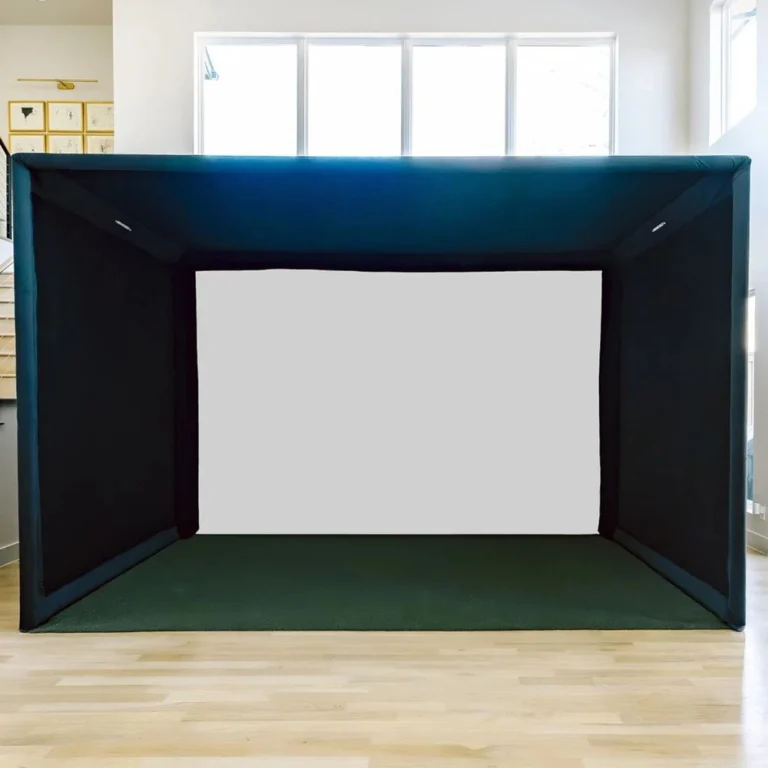
The SIGPRO Commercial line uses a more substantial construction path and offers custom sizes; its seller describes an open lower front that can avoid a bottom crossbar across the entry. That can be useful in a training studio or a permanent high-use space where foot traffic, durability and the finished experience matter. But a premium enclosure by itself does not include a launch monitor, compatible computer, projector or a professionally prepared room.
For example, SIG lists a commercial configuration measuring 10 ft 10 in wide, 8 ft 4 in high and 5 ft deep. Its recommended room is larger: 12 ft wide by 17 ft long with a 9 ft ceiling. Other commercial depths and sizes have their own requirements; these numbers must not be applied to the whole range.
Confirm structural support, wall and floor mounting, accessibility and how the enclosure is inspected after high-volume use. The cost of professional installation may be material; it is better to budget for it than to compromise a heavy frame assembly.
Trade-off: More expensive and less appropriate for a temporary garage shared with a car.
Before ordering: Verify local installer requirements, actual frame material and full package contents for the exact commercial order.
7. GoSports Simulator Enclosure — A Frame-and-Screen Kit
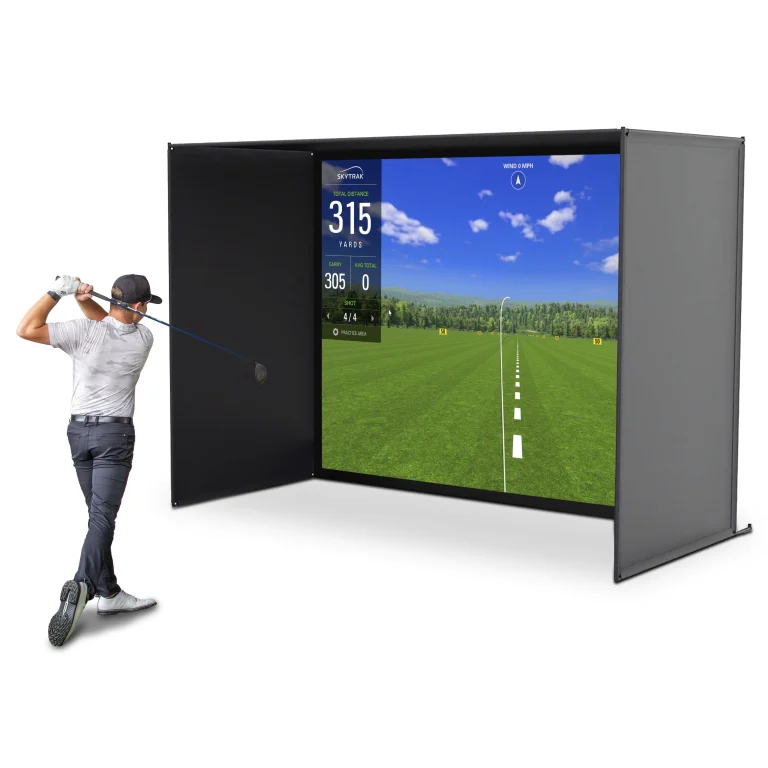
View 10 × 8 ft on Amazon View 12 × 9 ft on Amazon View 14 × 8 ft on Amazon
GoSports provides a manufacturer-defined enclosure family with frame, impact screen and surround. The Amazon family distinguishes 10 by 8, 12 by 9 and 14 by 8-foot options. Treat those as model labels, then read the exact outer-frame measurements for the selected kit. For example, the maker lists the 12 by 9-foot model at 12 feet wide, 9 feet high and 6 feet deep.
Its appeal is selecting a matched screen and frame rather than sourcing fabric and pipe independently. The launch monitor, projector, computer and hitting mat are not made part of the purchase merely because they appear in a finished-room photograph. Allow the required screen setback and full swing clearance beyond the frame. A frame that fits against a wall can still leave too little room to play.
8. GoSports Range Cage ELITE — An 8 × 8 ft Screen-Cage Option
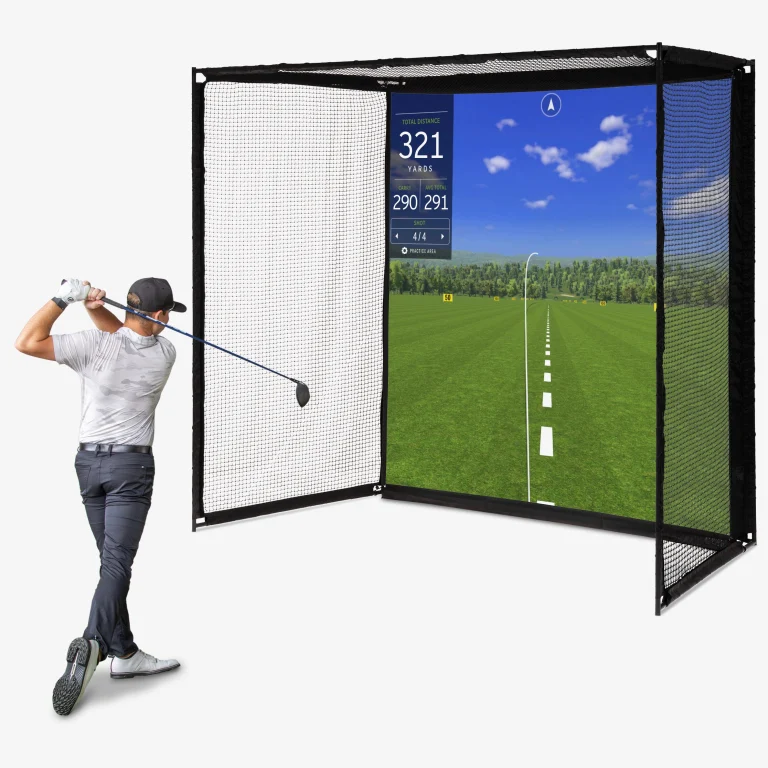
View Range Cage ELITE on Amazon
The Range Cage ELITE is a different GoSports product from its fabric-sided simulator enclosure. The named Amazon model includes an 8 by 8-foot impact-screen format with a cage structure. It is a useful comparison when catching protection and an open net design suit the room better than a darker enclosure surround.
The screen-size label is not the outer frame size or a safe room minimum. Check the full assembled footprint, support positions and ball-to-screen distance before choosing the mat position. An open cage also admits more surrounding light, so assess projected image visibility in the actual room. The impact screen does not include a projector, launch monitor or separate hitting mat.
The measurement sequence that prevents expensive mistakes
Start with ceiling height at the lowest obstruction, not at an empty corner. Then measure the safe working width for a driver swing, the length needed by your monitor and the floor position of the hitting mat. Only after that should you select the enclosure’s outer frame size. Finally, choose the usable screen width and projector throw. This sequence avoids buying a beautiful 12-foot enclosure for an 11-foot-wide bay. A frame also needs installation clearance and a recommended rear buffer; Carl’s documentation describes rear clearance needs for its DIY family.
Write down the difference between the advertised “screen size” and outer “frame width.” The enclosure may have five-foot side walls even if the image is much less wide. Garage door tracks are especially hazardous because the lowest obstruction may be well below the nominal ceiling.
What enclosure-only actually includes
A typical named enclosure might include an impact screen, dark surround, pipe connectors and a frame. Other listings supply fittings without the raw pipe lengths, or add a landing pad and hitting mat only in a higher-tier simulator package. The Indoor Golf Shop lists screen, frame and surround for its enclosure families; monitor, projectors, computers and some accessories depend on the package. Read each line item. “Compatible with a launch monitor” is not evidence that one comes in the box.
Ask whether side nets, overhead baffles, protective cushions, spare bungees, landing turf, frame-pipe padding and floor protection are included. Some are optional accessories; buying them later may change your real total materially.
A safe containment plan
The impact screen handles intentional full shots, but the enclosure must also account for a ball hit into the frame, ceiling, side wall or floor. Avoid leaving rigid tubing or sharp edges exposed in a likely ricochet path. Install side containment, overhead protection and floor coverings as prescribed by the maker. Use a proper rated impact surface, not standard projector cloth. If anyone is new to golf, assess a larger margin for poor contact and shanks.
Do not assume an indoor golf enclosure protects bystanders outside its projected face. Keep people and pets out of the hitting zone. Inspect attachments and fabric condition periodically, especially where repeated impacts concentrate.
Choosing between standard and custom enclosures
A standard SIG8/10/12 can be convenient because replacement parts and screen shapes are established. Custom kits can make sense around beams or unusual widths, but demand detailed measurement and more installation responsibility. For a multiuse garage, a temporary hitting net may be smarter than a five-foot-deep permanent enclosure that makes car parking impossible. If your budget is limited, protect the hitting area before upgrading image size.
Product-only versus finished simulator: purchasing scope
Even when an enclosure product includes a frame, blackout material and impact screen, it normally does not establish that a projector, PC, launch monitor, compatible mat, wiring and software licenses are included. Some DIY frame kits require separately supplied pipe or additional fittings; the exact selected kit configuration controls what ships. Verify a bill of materials before you compare totals.
Before ordering a permanent frame, use the shed planning example or the garage setup guide for the room that will contain it.
QUICK ANSWERS
Frequently asked questions
Select a question to reveal its answer.
Does an enclosure include a launch monitor?
Not necessarily. An enclosure-only product usually supplies a frame, screen and surround. Some simulator packages include a selected launch monitor, mat and other components; examine the exact SKU.
Is a SIG10 enclosure ten feet wide?
Its visible screen is around 10 ft 1 in across, but the complete frame is approximately 10 ft 10 in wide. Allow additional room beyond the frame.
Can I assemble a DIY enclosure without buying pipes?
Some suppliers offer pipe kits, while other DIY configurations list only fittings, screen and surround. Check the contents carefully before purchase.
Do I need a projector with an enclosure?
No. You can hit into a safe impact screen and display data on a tablet or monitor. Projection is optional and adds placement, light-control and hardware decisions.
Will a larger enclosure make a low ceiling safe?
No. The player’s actual swing clearance is independent of enclosure width. A tall frame can also conflict with ceiling lights, rails or beams.