
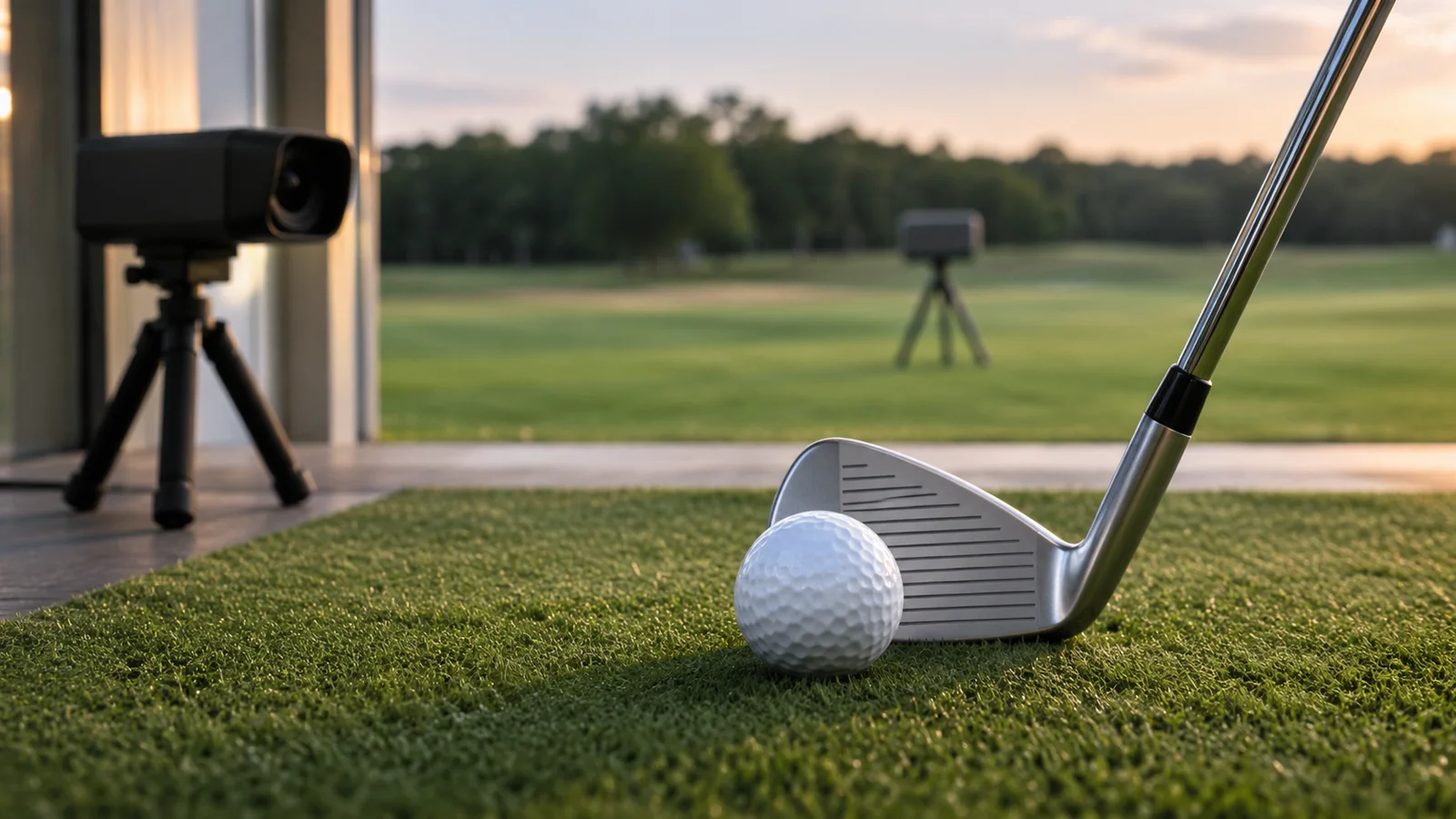
A golf launch monitor observes what happens when a club strikes a ball and converts that event into useful feedback: initial ball speed, launch direction, flight estimates and sometimes detailed club delivery. Not every monitor produces the same metrics or observes them in the same way. Some use Doppler radar behind the ball; some use high-speed cameras beside or above it; others combine sensors. Understanding that difference helps you buy for your room and interpret a reading correctly.
Quick answer: Radar measures motion over time and often benefits from a clear ball-flight lane. Camera-based systems capture frames around impact and can work in shorter bays when the ball stays in a defined hitting zone. Neither technology automatically guarantees a specific accuracy; setup, ball type, environment, firmware and the distinction between measured and estimated metrics all matter.
Radar vs camera at a glance
| Question | Doppler radar | High-speed cameras |
|---|---|---|
| Typical location | Behind ball aligned with target | Beside ball or mounted overhead |
| Key observation | Moving objects and frequency changes | Images of ball and club at impact |
| Indoor constraint | Rear position and ball-flight lane | Specified hitting area and lighting |
| Outdoor behavior | Suited to full flight when approved by maker | Varies; some optical models are indoor-only |
| Data caveat | Some club/spin values may be calculated | Some flight values extrapolated from early motion |
What radar actually detects
Doppler radar uses radio waves and the frequency change associated with a moving target to derive velocity information. In a golf context, a radar system processes reflected signals to identify the movement of the club and ball. Its software then translates observed movement into launch conditions and predicted trajectory. The number of antennas, processing design and manufacturer algorithms differ between products.
A portable radar sensor commonly sits behind the player along the target line. Its indoor performance may depend on enough room behind the ball and a prescribed amount of visible ball flight before a net. For example, Garmin R10 specifies six to eight feet behind the ball and at least eight feet toward the net. The actual safety footprint is larger once you account for the impact screen and swing clearance.
What camera-based tracking measures
Optical systems use one or more high-speed cameras, often with dedicated illumination, to capture the ball and possibly the club in a brief impact sequence. Frame-by-frame changes supply launch angle, direction and velocity; some systems track marked ball patterns or club stickers to improve spin or face measurement. A side-facing unit may need little space behind the golfer, while a ceiling-mounted unit may impose a strict mounting height and location.
Square Home is an example of an indoor-focused, side-positioned system. ProTee VX is a ceiling-mounted, dual-camera design. Their use cases are different, and an optical device made for controlled indoor lighting should not be assumed suitable for a sunlit range. The sensor manufacturer’s installation guide should override generic comparisons.
Measured versus calculated versus simulated
This is the vocabulary most important to a buyer. Measured usually means a sensor observes a quantity directly or derives it from directly observed motion within its measurement design. Calculated means software combines observed inputs and a model. Simulated means a projected flight or on-screen course response based on those inputs. Manufacturer terminology is not fully standardized, so review the specific metric definitions.
For example, a unit can measure ball speed and launch angle, then calculate carry based on spin assumptions and environmental settings. An accurate-looking simulated landing spot is not independent measurement of the complete flight when the ball traveled only a few feet into a net. Spin axis and club face readings deserve special attention because product tiers and approved ball markings can affect availability.
Why room depth changes the buying decision
The physical sensor arrangement explains why an indoor-only device may outperform a portable radar for convenience in a short room even when both are marketed as launch monitors. A radar monitor needs its specified rear lane; camera systems demand clear views of a designated hitting zone. A common mistake is to buy a sensor that needs more usable depth than the room provides, then attempt to correct missed shots by adjusting software settings.
Measure ceiling clearance for the actual golfer and club, side clearance for mishits, screen depth and any electronic mounting space. A safe swing and robust ball containment are independent of the sensor tracking needs. A nine-foot room with a beam in the swing arc might be less suitable than a slightly lower unobstructed location for an individual shorter swing—but neither should be presumed safe without checking.
How club data differs from ball data
Ball data describes the ball’s launch: speed, direction, launch angle, spin and resulting flight estimates. Club data can include club-head speed, face angle, club path, angle of attack and impact position. Some consumer launch monitors provide extensive ball metrics but limited club feedback; others offer extra club metrics only with an accessory or subscription.
Trackman defines smash factor as ball speed divided by club speed. This is a derived ratio, not a separate physical sensor. Similarly, carry distance under a net often reflects a model rather than a ground-truth measurement of an entire outdoor flight. The presence of a column in an app does not tell you whether that column is observed, estimated or available on your plan.
Spin: why marked balls and short-flight setups matter
Measuring spin is difficult when a ball makes only a short trip into a nearby screen. Some systems use a visible marked-ball pattern; some collect multiple observations to infer rotation; some estimate spin from other launch data. The MLM2PRO’s RPT-ball feature is a good example: Rapsodo describes measured spin with the approved RPT-pattern balls and supported subscription features. Do not assume an ordinary unmarked ball provides the same measurement path.
Comparing two devices for spin should use the same ball family, controlled strike, sensor placement and a suitable reference method. A reviewer who says a device is “tour accurate” after a few unstructured shots has not established a reliable error margin.
Why a launch monitor may miss a shot
Missed shots can come from the ball outside the hitting zone, incorrect radar alignment, unsupported lighting, reflections, moving metal objects, wrong ball markings, outdated firmware or an incompatible app connection. The proper diagnosis starts with the manufacturer’s setup diagram and a repeatable shot routine. If a sensor fails only with a particular wedge or putting stroke, check which shot types the maker claims to support.
Do not compensate for safety or geometry errors by moving the ball closer to an impact screen than the manufacturer permits. Likewise, do not tape optical sensors to unapproved positions or assume a calibration slider repairs a fundamentally poor installation.
Example: why two correct-looking numbers can come from different processes
Imagine a net session where the ball travels only eight feet before impact. The monitor may observe club speed and early ball speed, but the ball never flies through the entire arc needed to directly measure where it lands. Software can use observed launch inputs and its ball-flight model to predict carry. A displayed carry distance is therefore not evidence that the sensor watched the ball land.
| Displayed value | How to interpret it | Buyer question |
|---|---|---|
| Ball speed | Often captured shortly after impact by supported sensors | What are this model’s supported conditions and accuracy claims? |
| Carry distance | May be calculated from early-flight observations and a model | Does the maker distinguish measured and calculated values? |
| Smash factor | Derived ratio of ball speed divided by club speed | Are both underlying speeds available and consistent? |
| Spin rate | Can be observed or estimated, depending on sensor and environment | Do special marked balls, extra flight or a paid plan change the reading? |
Garmin’s R10 support documentation specifically lists ball speed, club speed and launch angle/direction under measured radar variables, while classifying carry, apex height and face angle as calculated. It also explains that indoor spin relies on modeled values and that certain outdoor flight conditions can permit radar-based spin measurements. This is a useful caution against treating two devices’ identical column labels as identical evidence.
Camera systems avoid some long rear-radar requirements by observing the strike close to the ball, but they introduce their own capture zones, lighting and ball-marking rules. “Radar versus camera” is not a universal accuracy ranking: compare the exact metric, setup, sensor quality and the person’s real practice use.
Which technology should a buyer choose?
Choose based on environment first. An outdoor range golfer can reasonably start with an approved portable radar system. A permanent compact indoor studio may favor an approved side-camera design. A multi-user commercial bay may benefit from an overhead camera that avoids repeated floor placement. Hybrids can combine practical advantages but add their own software, power and mounting requirements.
Then choose metrics. If you only want ball speed, carry trends and club gapping, a simpler unit may be sufficient. If you need measured spin axis, face-to-path feedback or a simulator ecosystem, confirm each metric, ball requirement and entitlement individually. The best model is the one that solves your actual practice problem in a usable room.
The on-course shot-tracking guide explains a different way of collecting golf data. The R10 review gives a practical example of measured versus modeled radar results.
Frequently asked questions
Are radar launch monitors better outdoors?
Many portable radar products are designed for outdoor practice and full-ball-flight observation. That does not mean all optical devices are unsuitable outdoors or all radar units work equally well; check specific manufacturer approvals.
Can a camera-based launch monitor work in a small room?
Some can use less rear depth than a radar unit, but they still need a manufacturer-approved hitting zone, suitable lighting, screen containment and safe swing clearance.
Does a launch monitor measure carry distance directly indoors?
Often carry is calculated from observed launch data because a net stops the ball before the full flight. Check how your particular sensor determines each data field.
Is smash factor a measured sensor reading?
It is a ratio calculated from ball speed divided by club speed, assuming both values are available. The quality of the ratio depends on the underlying input data.
Final recommendation
Think of radar and cameras as ways to observe the strike, not guarantees of performance. Evaluate the room, the exact measured fields, expected software costs and independent evidence before choosing. For specific picks, use Best Indoor Golf Launch Monitors or Best Launch Monitors for Driving Ranges, rather than assuming a technology winner from a marketing label.