
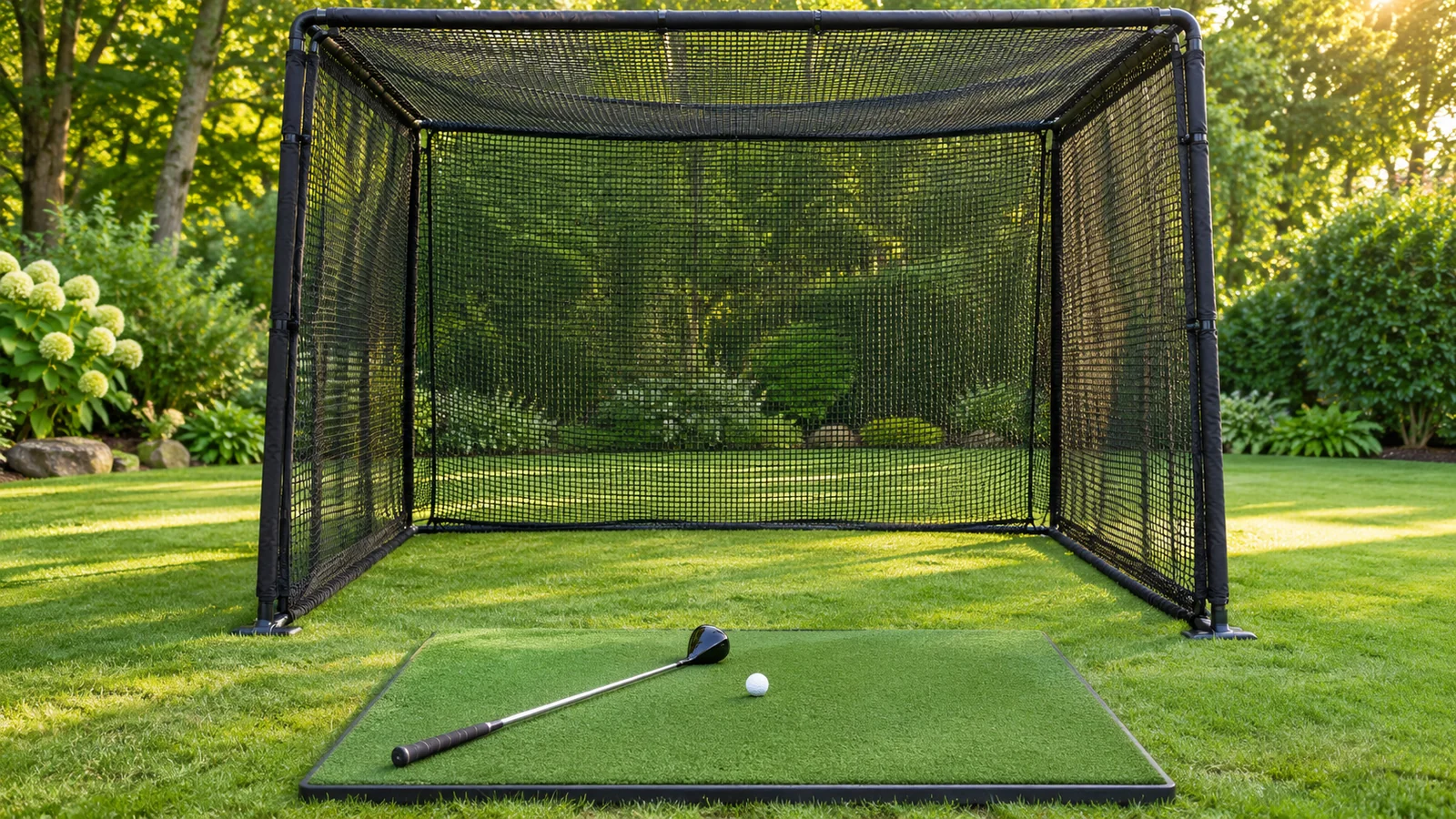
Net dimensions are not the entire safety envelope
Use the net’s effective catching width and height to judge real misses, not just its outer frame name. Spornia describes the SPG-7 as a seven-foot-class portable net and the SPG-8 as its wider and taller alternative; The Net Return distinguishes its 7-foot Home model from several larger Pro configurations. Both setups still need protection for high lofts, shanks, rebound, frame strikes and the area behind the net. Do not use any lightweight net with real balls until the manufacturer confirms that use and you have tested the actual clearances safely.
At a glance: comparison table
| Option | Good fit | Important trade-off | Check Price |
|---|---|---|---|
| Spornia SPG-7 | quick setup for regular home practice | Smaller catching area than SPG-8 or wider fixed stations | View on Amazon |
| Spornia SPG-8 | larger pop-up practice area | Larger and heavier than the smaller version; still a practice net rather than a full dark projection enclosure | View on Amazon |
| The Net Return Home Series | return-to-golfer stationary net | Less convenient than a pop-up design if the net must be disassembled daily; more hardware to store | View on Amazon |
| The Net Return Pro Series | durable wider practice station | A larger and more expensive footprint than many portable practice nets; side barriers may cost extra | View on Amazon |
| GoSports Range Cage with Simulator Screen | net cage with top and side protection | Larger frame and assembly footprint; projector and monitor must be purchased separately | View on Amazon |
| Rukket Haack Golf Net | portable wide net for backyard sessions | Net-only versions may omit the hitting mat; limited roof/side containment compared with a full cage | View on Amazon |
| GoSports Elite Golf Practice Net | simple broad practice format | The product family has multiple variants; do not assume every listing includes a simulator-rated screen, side protection or mat | View 10 ft net on Amazon |
A practice-net comparison should prioritize containment, installation stability, usage space and portability; a net is not interchangeable with an impact screen.
1. Spornia SPG-7 — quick setup for regular home practice
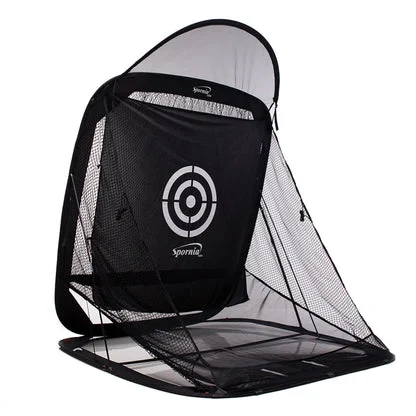
Spornia lists the SPG-7 as a roughly seven-foot-wide family of self-contained practice nets with a pop-up design and an automatic ball-return system. The attraction is convenient repetition: it can be set up for a backyard session and packed away when the space is needed for other things. It is appropriate to examine when a permanent 10-foot enclosure would be excessive.
The target net area should be assessed against your distance from the net and your likely miss pattern. A seven-foot front opening is not permission to swing from any distance or to leave a house window outside the protected zone. Side accessories may be appropriate for golfers who regularly hit lateral misses.
Trade-off: Smaller catching area than SPG-8 or wider fixed stations. Portable fabric still needs inspection and correct anchoring.
Before ordering: Verify whether the package includes side nets, target sheet, bag and all accessories shown in photographs.
2. Spornia SPG-8 — larger pop-up practice area
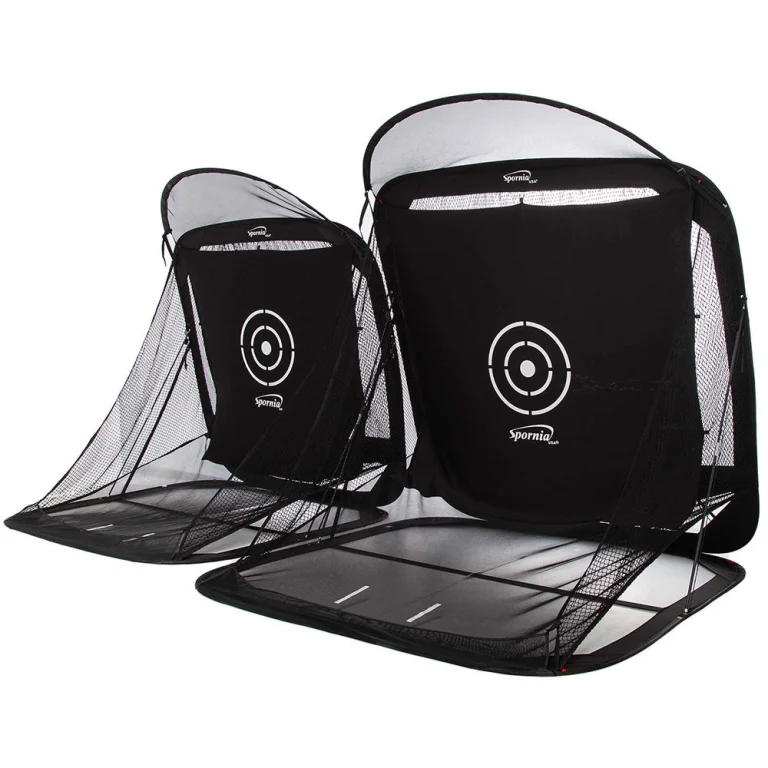
Spornia describes SPG-8 as approximately eight feet by eight feet and positions it as a useful size for a compact simulator-style net setup. It preserves the quick setup concept of the SPG-7 while offering more capture area for different clubs and players. That extra area can make indoor placement easier in some circumstances but needs more floor and storage room.
Use the SPG-8 when the smaller net would feel cramped and your garage width permits safe extension. A large face is helpful, but the net’s depth, roof shape and side extension options are just as important when practicing lofted irons.
Trade-off: Larger and heavier than the smaller version; still a practice net rather than a full dark projection enclosure.
Before ordering: Check current dimensions, side-protection options and compatibility with any impact-screen accessory.
3. The Net Return Home Series — return-to-golfer stationary net
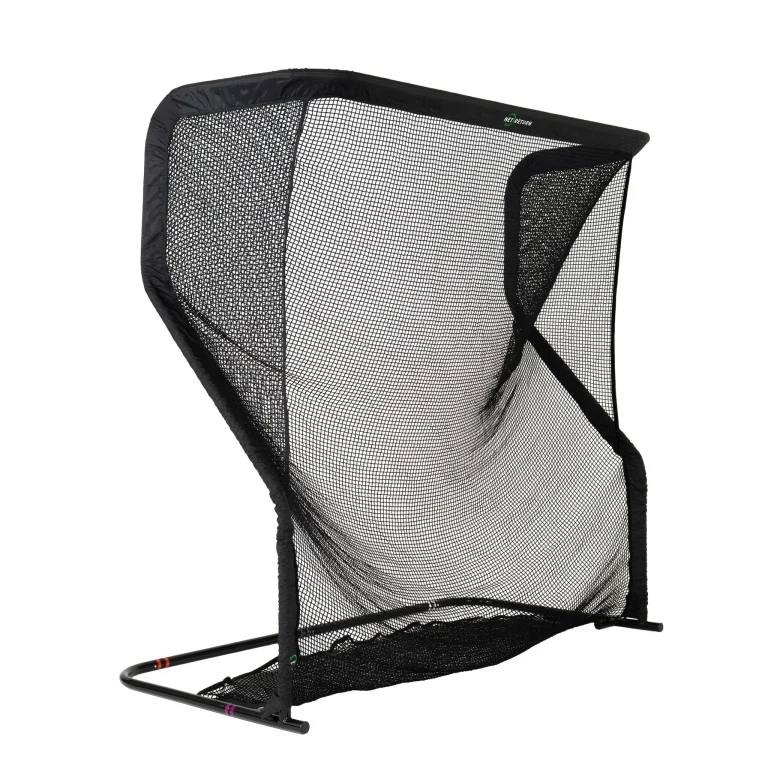
The Net Return Home is part of a more substantial freestanding net family built around a shaped frame and gravity ball return. Compared with a lightweight pop-up net, this style emphasizes a repeatable hitting station that can remain assembled in a garage or yard. Its home-sized format may be enough for a measured practice area without occupying the wider footprint of Pro variants.
An automatic return is useful when working through controlled wedge and iron sessions. For a fast swing session, the largest benefit is consistency: you do not have to walk forward to collect every ball. Confirm actual floor depth and any side barriers, because the return mechanism itself does not stop a poor shot missing the net.
Trade-off: Less convenient than a pop-up design if the net must be disassembled daily; more hardware to store.
Before ordering: Measure floor footprint and verify the exact Home package includes only the net or additional turf/side accessories.
4. The Net Return Pro Series — durable wider practice station
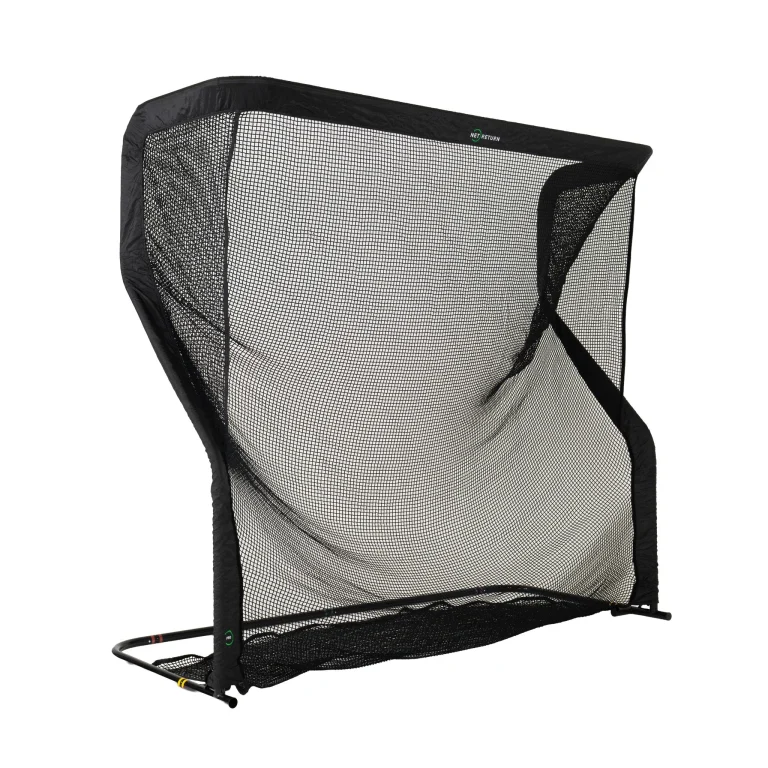
The Net Return Pro Series is published as an approximately eight-foot-wide, seven-foot-six-inch-tall model with a depth of about three feet six inches. The company emphasizes its free-standing frame and automatic return. This makes it an interesting option for a dedicated practice station, especially when a golfer hits frequently enough that convenience and replacement parts matter.
It is not enough to look at the face width. Check whether you have safe clearance on either side for wayward shots, and whether the ceiling permits lofted irons. A full simulator image requires the correct screen accessory, not merely the ordinary mesh net.
Trade-off: A larger and more expensive footprint than many portable practice nets; side barriers may cost extra.
Before ordering: Check the exact US Pro Series model, included bag/frame and optional side-barrier compatibility.
5. GoSports Range Cage with Simulator Screen — net cage with top and side protection
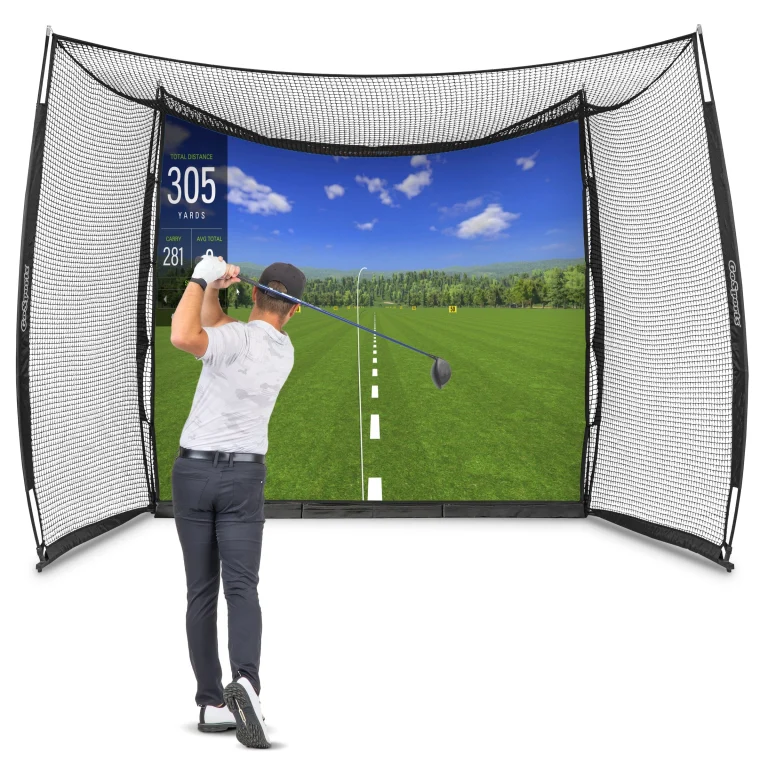
GoSports describes a roughly 10 ft wide by 8 ft high by 5.5 ft deep cage using protective top and side netting and an 88 by 80 inch impact-screen insert on the simulator configuration. This is more containment-oriented than a flat hitting net and can suit controlled indoor practice where high wedges are common. The launcher and projector are explicitly not included.
Because this model has a deeper cage, account for its floor footprint and where the golfer will stand. The screen may be convenient if future projection is planned, but do not buy it solely for that possibility: verify your monitor, PC and projector later.
Trade-off: Larger frame and assembly footprint; projector and monitor must be purchased separately.
Before ordering: Verify whether the exact seller lists the simulator-screen variant rather than a net-only Range Cage.
6. Rukket Haack Golf Net — portable wide net for backyard sessions
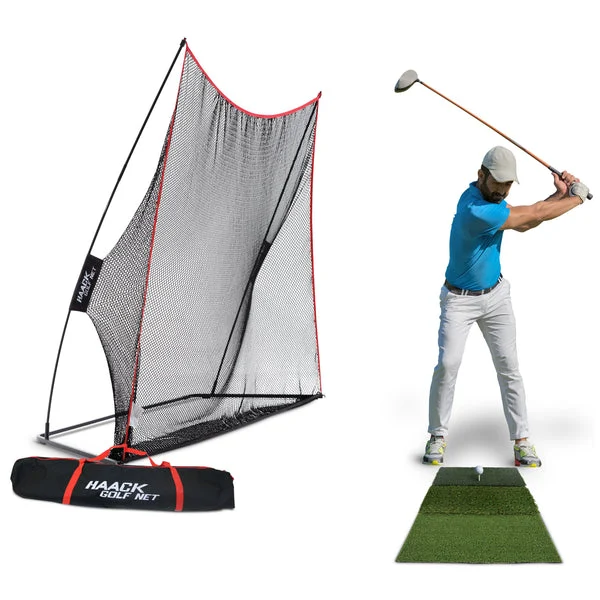
Rukket describes the Haack net as a roughly ten-foot-wide, seven-foot-high practice net with portable frame components and a dedicated target area. The wider face is attractive for golfers who want a broad visual landing area and do not want a fully enclosed simulator structure. The net is also sold in variants with a small tri-turf mat, which should not be confused with a full standing mat.
Consider this for outdoor practice when there is ample buffer behind the structure and you can anchor it appropriately. The bundled small mat can help with tee-shot repetition, but a full-swing player may still benefit from a more substantial stance surface.
Trade-off: Net-only versions may omit the hitting mat; limited roof/side containment compared with a full cage.
Before ordering: Check the exact US product name, current frame size, anchors and whether the chosen listing is a bundle.
7. GoSports Elite Golf Practice Net — simple broad practice format
View 7 ft on Amazon View 8 ft on Amazon View 10 ft on Amazon
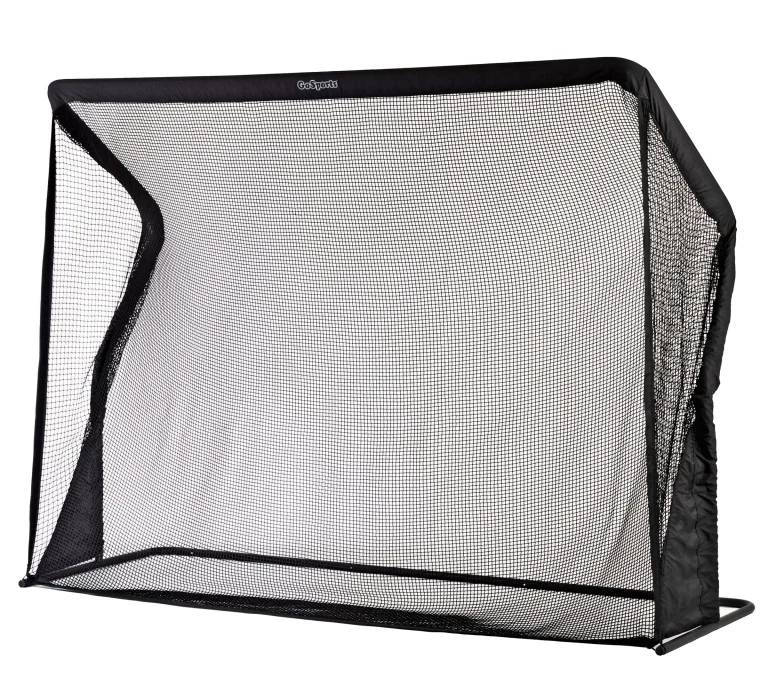
GoSports offers its Elite steel-frame net in 7 × 7, 8 × 8 and 10 × 7-foot named sizes. Its diagrams give assembled footprints of approximately 7.5 × 7.5 × 3.5 feet, 8.1 × 8.1 × 3.7 feet and 10 × 7.5 × 3.5 feet respectively (width × height × depth). Measure the actual frame rather than treating the size label as the complete room requirement.
Evaluate the model on three practical criteria: catching width, resistance to shifting on the intended surface and ease of replacement netting. A simple broad net can be a better fit than a full cage if you practice outdoors in a protected area and do not need projected images.
Trade-off: The product family has multiple variants; do not assume every listing includes a simulator-rated screen, side protection or mat.
Match net size to your realistic miss pattern
The usable catching opening is not the same as the room width or the advertised frame dimensions. A golfer practicing with a wedge might launch a ball much higher than expected; a driver can produce a lateral miss. Evaluate the likely ball path and what lies beyond all edges, not merely whether the center target is large. A roof or side panel can help catch certain errors, but only when installed for that use and inspected regularly.
Net size by itself is not a safety guarantee. The farther you stand, the more widely poor shots may spread before reaching the net. If your net manual requires a particular hitting distance or anchor configuration, follow it instead of an internet diagram.
Portable pop-up versus free-standing frames
A pop-up net reduces setup time and storage demands but relies on the condition of flexible parts and correct anchoring. More rigid systems can create a repeatable area with automatic ball return and accessory options, but may be slower to dismantle and take more garage space. Choose for the real routine. If you remove the net every afternoon to park a car, a technically superior large frame that no one wants to assemble is not a sensible purchase.
For indoor practice, examine whether the frame exposes hard parts in the ball path, and what protection the seller specifies. Do not improvise a rigid net stretched against masonry.
Adding a launch monitor to a practice net
A net does not make an incompatible monitor work indoors. Garmin R10 specifies its sensor six to eight feet behind the ball and at least eight feet of ball flight before the net; other radar units have different requirements. A smaller camera system may occupy less room behind the ball but can have its own lighting, hitting-zone and software constraints. A monitor that works on a full driving range might report different or restricted data in a short-flight garage.
If you plan to add software, start by checking the required device and net geometry. You can practice with a monitor and tablet without a projector. A net and a launch monitor alone should not be advertised as an all-inclusive projected simulator unless the remaining components are actually included.
Mat quality and repeatable stance
The net is only one half of the physical practice station. A mat must stay in place, support a normal swing and give a consistent ball height. A thin tri-turf pad can be convenient for limited drills, but it is not necessarily a comfortable full-body standing surface. If a golfer stands on the garage floor and hits from a raised mat, the height difference can change setup and swing; match surfaces deliberately.
For repeated full shots, a larger supported mat may be worth considering. Choose a product appropriate for the surface underneath, and keep water, loose rugs and balls out of walking paths.
Maintenance and storage checklist
Before each session, check for frayed net panels, broken frame sections, worn retaining straps, loose anchors and damage near the main impact zone. After rain or outdoor storage, follow the maker’s cleaning and drying instructions. Protect electronics and mats from prolonged moisture. Where a ball repeatedly contacts the same panel, wear can be localized even when the rest of the net looks new.
Do not hit into a visibly damaged net, and stop if a ball passes through or rebounds unpredictably. Safety means replacing worn parts rather than expecting the next swing to behave differently.
What to check before buying on Amazon US
Match the model, size, frame, target panel, side barriers and any screen to the written included-parts list. Confirm condition, seller, warranty and return terms before buying.
Manufacturer model variants can invalidate a listing
Read the exact size, version and included-parts list. A family name may cover net-only products, replacement fabric and screen-equipped kits, which have different contents.
The outdoor simulator guide explains temporary-session weather and sensor limits. Compare the net-and-mat bundle guide if the net also needs a portable strike pad.
Final recommendation
Choose a net for the actual place and practice routine.
Spornia’s pop-up families suit temporary sessions, The Net Return is worth considering for a repeatable return-to-golfer station, and a full cage may better fit a permanent garage.
Whatever the model, prioritize catching area, safe back and side space, correct anchoring and maintenance.
A setup that cannot safely contain your realistic misses is not worth the purchase.
QUICK ANSWERS
Frequently asked questions
Select a question to reveal its answer.
Can I hit real golf balls into a practice net?
Only if the manufacturer rates the net for real golf shots and the net is installed, inspected and used according to its instructions. Surrounding space must also be safe.
Is a 7-foot net enough?
For some golfers and shot types yes, but shot dispersion, loft, player skill and striking distance matter. Consider larger capture area and side protection where needed.
Can I turn a practice net into a projected simulator?
Sometimes, with an appropriate impact screen or compatible accessory, a launch monitor, software and a display. Ordinary net mesh is not a proper projected impact screen.
Does automatic ball return improve practice?
It can reduce interruptions and make controlled repetition easier. It is a convenience feature, not proof of a more accurate launch monitor or a safer setup.
Should I buy a bundle with a small hitting mat?
It can be convenient for portable drills, but check the size. A small tri-turf pad is not automatically a full standing platform suitable for lengthy full swings.